
The Empire City Rises · December 16-17, 1835
The Great Fire of 1835
A store fire in freezing weather burned nearly 700 buildings and 23 blocks of downtown New York in one night in 1835, and bankrupted every fire insurance company the city had.
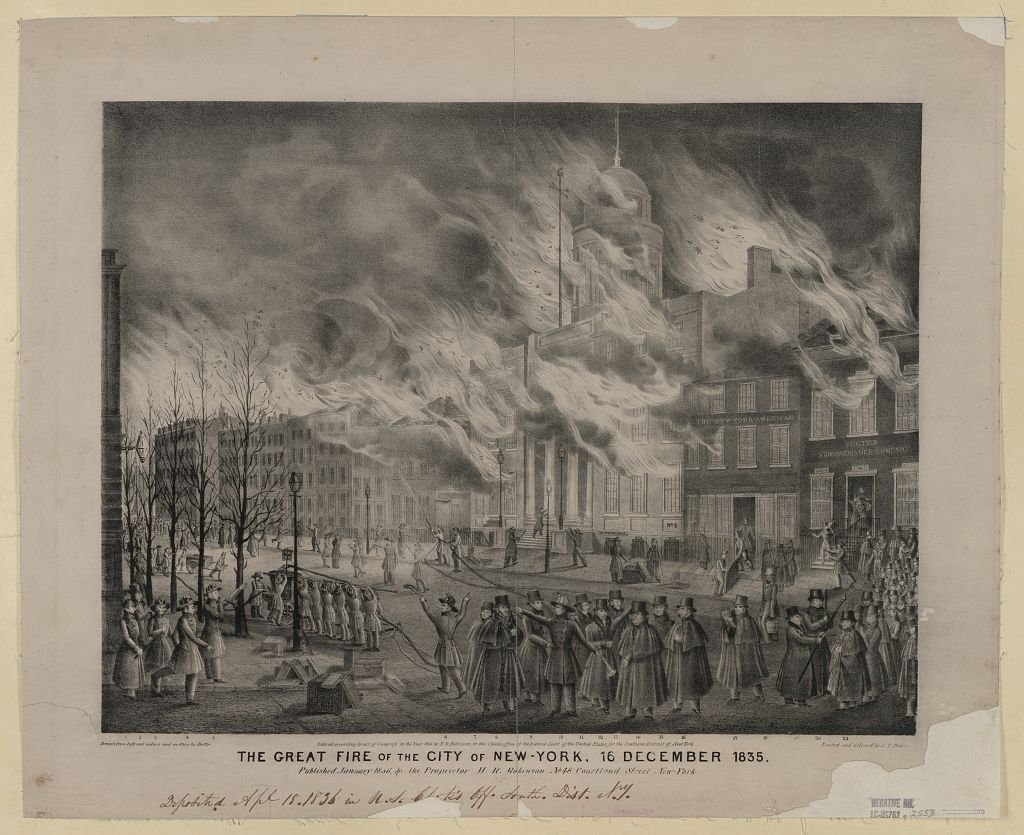
The facts
- When
- The night of December 16 into December 17, 1835, in bitterly cold weather
- Where it started
- The store of Comstock & Adams on Merchant Street, a warehouse block near Hanover and Pearl streets
- The toll
- Close to 700 buildings across about 23 blocks, by later merchant-committee counts; Philip Hone's diary the morning after put it at 570
- The cost
- Estimated at $18 million to $20 million in 1835 dollars; every fire insurance company in New York was left insolvent
- The landmark lost
- The Merchants' Exchange on Wall Street burned to its facade and marble columns; its collapsing dome destroyed a statue of Alexander Hamilton installed eight months earlier
- Why it spread
- Bitter cold froze water in the hydrants and hoses, crippling firefighters already exhausted from a fire the night before
New York's costliest fire before the twenty-first century started small: a store fire on Merchant Street, a warehouse block near Hanover and Pearl streets, on the bitterly cold night of December 16, 1835. Cold did the worst damage. Water froze in the hydrants, hoses stiffened uselessly, and exhausted firefighters, already worn out from a fire the night before, could not stop flames jumping block to block through the city's densest commercial district. Philip Hone, the former mayor, walked to the fire to save his son's store and wrote what he saw the next morning: the Merchants' Exchange on Wall Street burned down to its facade, its collapsing dome destroying a statue of Alexander Hamilton installed only eight months before. By the time it burned out, close to 700 buildings across some 23 blocks were gone, at a cost merchants and insurers eventually put at $18 million to $20 million, bankrupting every fire insurance company in the city. New Yorkers spent decades turning the disaster into legend, and some insurers turned it into an advertisement.
In their words
The event in the voices and documents of the people who were there. Every source links out so you can check it.
-
Diary
Hone, a former mayor and prolific diarist, wrote this the morning after, his first attempt to put a scale on what he had seen overnight.
Nearly one-half of the first ward is in ashes, five hundred to seven hundred stores, which with their contents are valued at $20,000,000 to $40,000,000, are now lying in an indistinguishable mass of ruins. There is not, perhaps, in the world the same space of ground covered by so great an amount of real and personal property as the scene of this dreadful conflagration. The fire broke out at nine o'clock last evening.
Philip Hone, diary entry, December 17, 1835
His own estimate moved within the same entry, from '$20,000,000 to $40,000,000' at the top of the page to 'something over $15,000,000' a few paragraphs later, once a newspaper's tally reached him.
Source: The Diary of Philip Hone, 1828-1851, ed. Bayard Tuckerman (Dodd, Mead and Company, 1889), p. 180-181 -
Diary
Hone's account of why the fire spread as fast and as far as it did.
The night was intensely cold, which was one cause of the unprecedented progress of the flames, for the water froze in the hydrants, and the engines and their hose could not be worked without great difficulty. The firemen, too, had been on duty all last night, and were almost incapable of performing their usual services. The fire originated in the store of Comstock & Adams, in Merchant street.
Philip Hone, diary entry, December 17, 1835
The dome of the Merchants' Exchange fell in later that night, Hone wrote, destroying a statue of Alexander Hamilton by Ball Hughes that had stood in the rotunda for only eight months.
Source: The Diary of Philip Hone, 1828-1851, ed. Bayard Tuckerman (Dodd, Mead and Company, 1889), p. 180 -
Document
A later, settled accounting of the fire's scale, drawn from the Society's own archives, against which Hone's same-morning estimate can be measured.
the bitterly cold temperatures that froze the water in their firemen's hoses, the destruction of the nearly 23 blocks and 700 buildings in the city's prosperous mercantile district, the estimates of damage that ranged from $18 to $20 million
Dr. Jane Manners, Bernard and Irene Schwartz Fellow, 2018-2019
The same essay documents how competing newspapers raced to cover the fire: the New York Herald ran its first illustration ever, a woodcut of the ruined Merchants' Exchange, on December 21, 1835, and the New York Sun printed 30,000 copies of an extra edition.
Source: New-York Historical Society, "The Great New York Fire of 1835 and the Marketing of Disaster" -
Document
A line attributed to Aetna's president, published as a company reminiscence more than three decades after the fire it describes.
Go to New York and pay the losses, if it takes every dollar, and my own fortune besides.
Aetna Insurance Company advertisement, circulated in newspapers beginning spring 1869, dramatizing events of December 1835
There is no 1835 record of this line. It appears first in an 1869 advertisement, part of a decades-long pattern of insurance companies using the fire to market their own reliability.
Source: New-York Historical Society, "The Great New York Fire of 1835 and the Marketing of Disaster"
What people get wrong
-
The myth The fire's toll, in buildings and dollars, is a single settled number.
What’s true Even eyewitnesses disagreed within a day. Philip Hone's diary the morning after estimated "five hundred to seven hundred stores" worth "$20,000,000 to $40,000,000," then revised itself lower in the same entry, citing a newspaper's count of 570 buildings and just over $15,000,000. Merchant committees later settled on figures closer to 700 buildings and $18 to $20 million, the numbers most often quoted today.
-
The myth The line about an insurance president vowing to pay every loss, 'if it takes every dollar,' is something he said in 1835.
What’s true It is a marketing flourish from decades later. The quote first appeared in an Aetna Insurance advertisement circulated in newspapers starting in spring 1869, more than thirty years after the fire, as part of a wave of insurance-company advertising built around the disaster.
-
The myth This was simply a very bad fire that happened to be memorable.
What’s true Historians who have studied the New-York Historical Society's own archives argue its fame was partly manufactured: competing newspapers rushed out illustrated extras, print sellers marketed engravings of the ruins for years afterward, and insurers kept invoking it in advertising into the twentieth century, turning a disaster into what one historian calls a 19th-century "cultural touchstone."
What it changed
- Every fire insurance company operating in New York in 1835 was left insolvent, a collapse that pushed the state toward stronger capital requirements for insurers.
- The fire exposed how little water the city could move in an emergency, hydrants frozen and pressure too weak, an argument later used to push the Croton Aqueduct project forward.
- James Gordon Bennett's New York Herald, only months old, ran its first-ever illustration on December 21, 1835, a woodcut of the ruined Merchants' Exchange, one early step toward illustrated news as a fixture of American newspapers.
- A new Merchants' Exchange, designed by Isaiah Rogers, rose on the same Wall Street site and was completed in 1841.
- The fire remained a fixture of American memory for decades, invoked in insurance advertising, memoirs and art, including Thomas Cole's 1836 painting 'The Course of Empire: Destruction,' finished only months after the blaze.
The New York Shelf
Read the whole story
Paid link. If you buy a book through this link, Bookshop.org pays us a small commission and sends a share of the sale to independent bookstores.
-
The history
Gotham (opens Bookshop.org)
Edwin G. Burrows and Mike Wallace · 1999
Burrows and Wallace cover New York from its earliest settlement to consolidation in 1898, in a single volume of more than a thousand pages. It won the Pulitzer Prize for History.
The city is still writing this.
Four centuries end at this morning’s news. The daily brief picks up where the history leaves off: what changed in New York today and what it means, explained by breakfast.
Free. One email each morning. One-click unsubscribe. Never sold.