
How it works
How the brief gets made.
As of October 2026: one morning read across the city's local desks (43 sources and 318 articles in the latest sweep, spanning 9 categories), one brief in which every claim is cited and every quote is checked against its source, and 103 ongoing storylines carrying 584 dated entries you can catch up on any time. This page is the entire method.
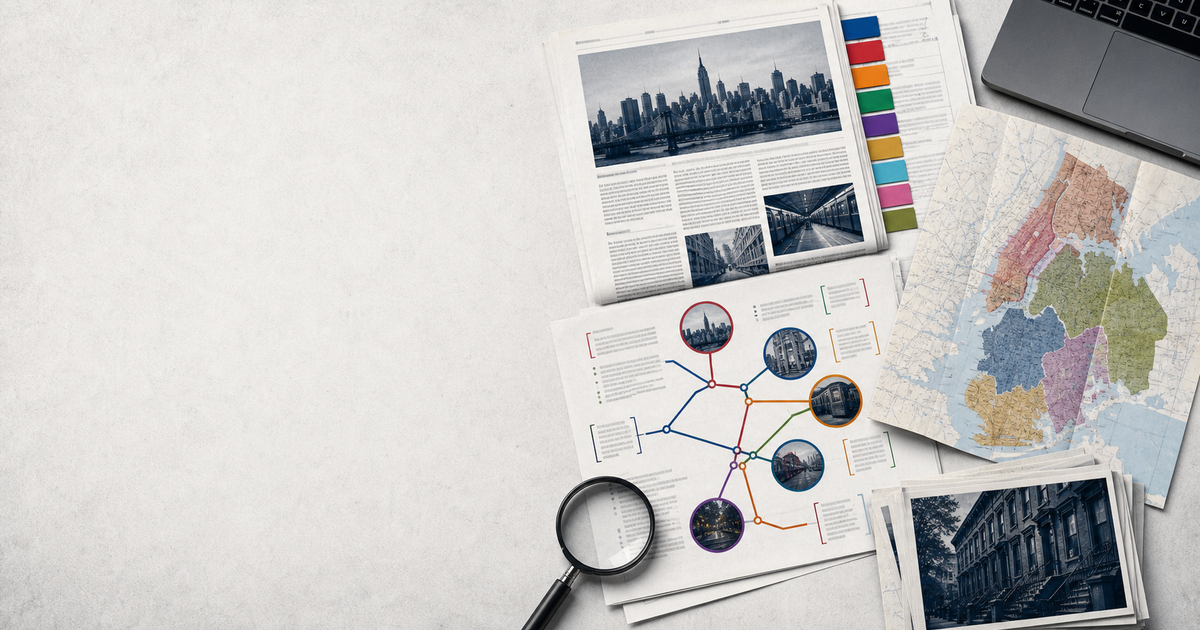
The morning read
Every issue starts the same way: a morning sweep of the local desks that actually cover New York, a fixed roster of 49 local newsrooms and feeds across 9 categories, from THE CITY, Gothamist, and the Post to Streetsblog, Chalkbeat, Crain's, The Real Deal, Eater, and the team blogs. The roster is chosen to span every borough and Albany, and every outlet on it is public: see the desks we read.
The read is full text, not headlines. In the latest sweep, on October 14, 2026, that meant 318 articles from 43 sources, all of it on the desk before a word of the brief is written. The only things dropped before the read are duplicates and junk headlines; there is no engagement algorithm deciding what you get to see.
What makes the brief
Selection is editorial judgment against a fixed test, the same every morning. A story earns its place by answering three questions in order: what actually happened, what it means for how you live here, and what it teaches you about this city. The day's biggest stories are clustered wherever they ran, so one event covered by five outlets reads as one story, not five.
The lead account comes from the desks that just report it, before anyone sells a take. Then the brief does the part a feed never does: it says the so-what out loud, for your rent, your commute, and your block, and it shows how the rule, agency, or budget behind the story works. The 9 categories and the questions asked of every story are fixed and public; browse the coverage by topic to see the framework at work.
The sourcing rules
These are not aspirations. Each rule is checked mechanically before a brief is allowed to publish.
- Every claim is cited. Each story carries numbered citations tied to specific articles, and a checker verifies that every citation points at the article the sentence names.
- Single-source claims are named as such. Something is stated as established only when two or more independent outlets corroborate it. A striking claim carried by one outlet is attributed to that outlet by name, never laundered into the neutral record.
- Quotes are verified character for character. Every quoted phrase must be an exact, contiguous copy of the cited article's text. A reworded quote is flagged; a quote that appears in no source is treated as a fabrication, and the brief does not publish.
- Figures are checked. Every number a story presents must be a number its cited source actually gives.
- Names need a home. Every person, agency, and place named in a story has to appear somewhere in the day's sources; an unsourced name is flagged before publish.
Behind all of it sits a quality gate that would rather publish nothing than publish garbage. A brief that comes up thin, with too few stories, too few categories, or missing sections, is held, and a fabricated quote or figure stops publication outright. That is why the archive can have a gap: a missing morning means the brief did not clear the bar, not that nobody checked.
Storylines
A daily brief expires at midnight; the stories in it do not. Storylines are the fix: one permanent page per ongoing New York story, each a dated timeline of what has actually happened, with every entry sourced to the coverage that reported it. When the morning brief advances one, its timeline grows the same day. As of October 2026 the desk keeps 103 storylines carrying 584 dated entries.
They exist so you never have to pretend you have been following something for six months. A rezoning, a fare hike, an admissions fight: pick it up at any point and the timeline catches you up in four lines. Browse the storylines.
Corrections
Errors get fixed fast and in the open. If you spot one, email hello@newyorkexplained.com or reply to any brief; it reaches a real person. The page is corrected, a note says what changed, and the fix is logged on the public corrections page, where the standing policy lives too.
How to cite this site
Every brief lives permanently at a stable, dated URL: newyorkexplained.com/briefs/YYYY-MM-DD/. Link the dated brief, not the homepage, and attribute it to New York Explained. Because each story names the outlets behind it, any claim can be traced past us to the original reporting.
The storylines are also permanent and dated, and every civic explainer links the public documents it is built on, so both can be cited the same way.
Who makes it
New York Explained is written and edited at the city desk. The desk does the morning read, writes the brief against the rules above, tends the storylines and the reference shelves, and answers the mail. It is independent and founder-owned, funded by readers, and not owned by anyone it covers; the ownership details are on the About page.
Questions about the method
How many sources does New York Explained read each morning?
The roster is 49 local newsrooms and feeds across 9 categories, and the number carrying New York news varies by day: the latest read drew 318 articles from 43 sources. Every outlet on the roster is public, on the sources page.
How do stories get picked?
By a fixed editorial test, not by clicks: what actually happened, what it changes for how you live here, and what it teaches you about the city. The loudest crime headline usually fails that test. A quiet rule change that moves your rent usually passes it. The mix matters too: schools, trains, restaurants, parks, and teams are the city as much as City Hall is.
What does "explained" actually mean here?
Two things. Every story states the so-what in plain language: what changed and what it means for your rent, your commute, your schools, or your block. And when a story rests on a piece of city machinery, how a rent increase gets set, what a community board can actually decide, who runs the LIRR, we explain that machinery in a sentence, right where you need it. If a story would read the same in any city, it does not make the brief.
How do I know a quote in the brief is real?
Every quoted phrase is checked character for character against the cited article before publication. A quote that cannot be verified is cut, and a quote that appears in no source blocks the whole brief from publishing.
What happens when outlets disagree?
Something is stated as established only when two or more independent outlets corroborate it. A claim carried by a single outlet is attributed to that outlet by name, and a genuine contradiction is flagged as a dispute rather than silently resolved.
What happens on a bad morning?
Nothing goes out. A brief that comes up thin or fails a fabrication check is held rather than published, which is why the archive can have a missing date. Silence beats garbage.
What are Storylines?
Permanent pages, one per ongoing New York story, each a dated, sourced timeline plus a what-comes-next card. When the morning brief advances one, its storyline grows the same day. Pick up a six-month story at any point and be current in four lines. There are 103 of them as of October 2026.
Does the brief tell me what to actually do in New York?
Yes. Every brief closes on Worth Doing: a handful of real things to go see, eat, or attend, with where they are, when they run, and what they cost, plus one practical "good to know" line about getting around the city. Every item is sourced to a story from that morning, so nothing in it is invented.
How do I cite or link a brief?
Every brief has a permanent dated URL at newyorkexplained.com/briefs/YYYY-MM-DD/. Link the dated brief and attribute it to New York Explained. Each story names its outlets, so any claim can be traced to the original reporting.
How do corrections work?
Email hello@newyorkexplained.com or reply to any brief; it reaches a real person. Real errors are corrected on the page, with a note saying what changed, and every correction is logged publicly at newyorkexplained.com/corrections/.
Who writes New York Explained?
It is written and edited at the city desk, and it is independent and founder-owned: no media conglomerate, no political party, no advocacy group. It is funded by readers rather than by anyone it covers.
Is any of it paywalled?
No. The brief, the storylines, the explainers, and the history are all free. Members who want to keep it independent chip in $5 a month. That is a membership, not a paywall.
Start reading New York.
One short brief. Your whole city, explained, plus what is worth going out and doing. Free every morning.
Free. One email each morning. One-click unsubscribe. Never sold.