
The Modern Metropolis · 1890-1901
Jacob Riis and the Tenement House Act
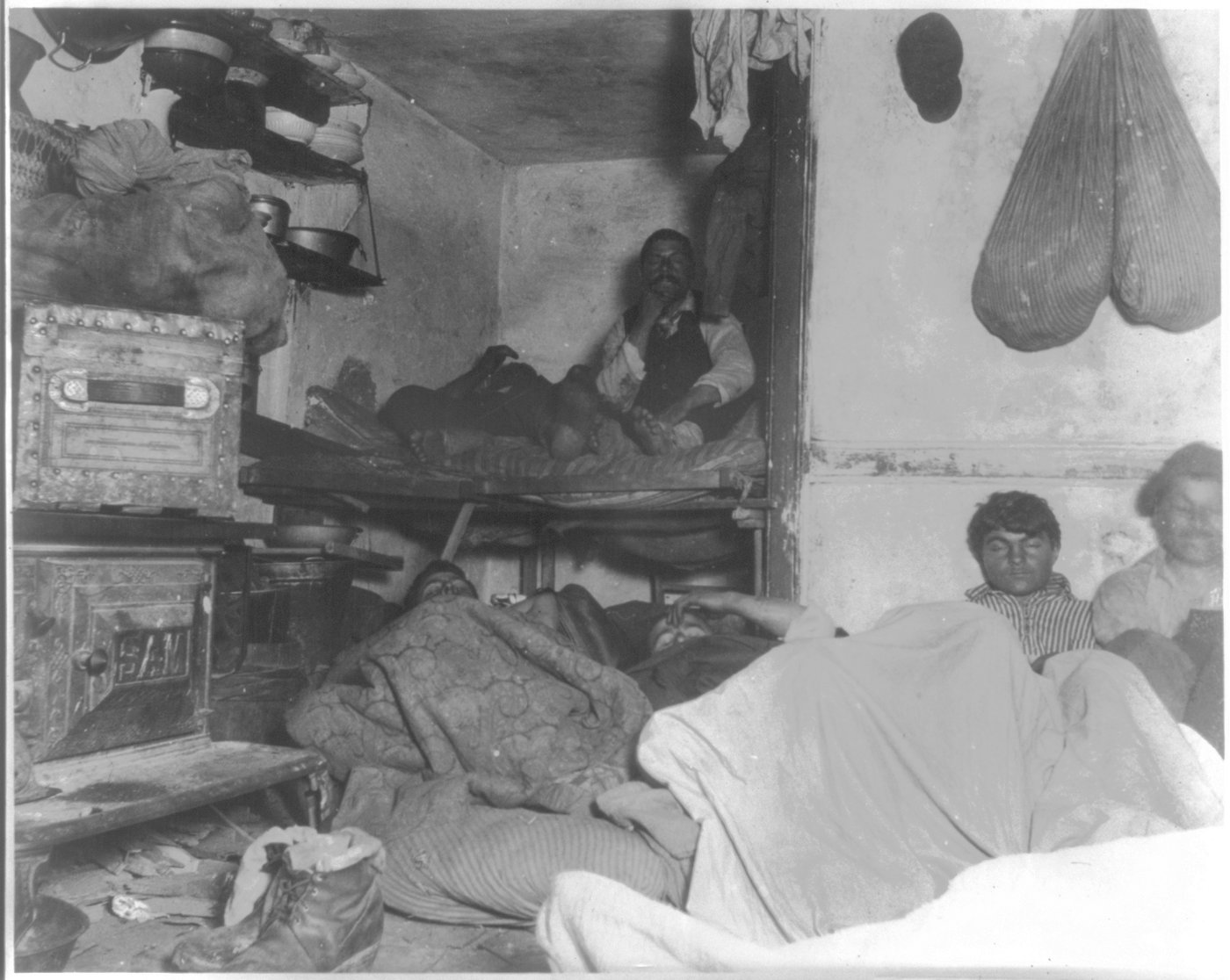
Jacob Riis photographed how New Yorkers packed 290,000 people to the square mile. Eleven years later, in 1901, the state finally wrote enforceable rules for a tenement.
The facts
- The book
- Jacob Riis, "How the Other Half Lives: Studies Among the Tenements of New York," published 1890, illustrated with photographs Riis took himself
- The density
- Riis put the Lower East Side's population at roughly 290,000 people per square mile in 1890, among the highest in the world
- The law
- The Tenement House Act, Chapter 334 of the Laws of 1901, became law April 25, 1901, applying to New York and other cities of the first class
- What counted as a tenement
- Any building housing three or more families living independently and cooking on the premises, or more than two families to a floor
- The fix required
- Existing basement rooms had to get a window opening to outer air of at least nine square feet, at least four and a half square feet of it operable
- The enforcer
- The Act created a new Tenement House Department, separate from the Health and Buildings departments, to inspect and license tenements
Jacob Riis was a police reporter before he was a reformer, and it showed. "How the Other Half Lives," his 1890 book of tenement reporting and photography, opened with an old saying turned into an argument: the rich did not know how the poor lived because they had never had to care. Riis walked the Lower East Side with a camera and flash powder and put a number on what he found, about 290,000 people to the square mile, among the densest crowding anywhere on earth. The book did not pass a law by itself. A Tenement House Committee formed in 1898 turned public sympathy into a legislative campaign, staging a Fifth Avenue exhibition in February 1900 that led to a state commission under Robert W. De Forest and Lawrence Veiller. Their bill became the Tenement House Act on April 25, 1901, the first law to define a tenement in enforceable detail, ban unlit interior rooms, require existing basements to get a real window to outside air, and create a Tenement House Department with power to inspect and condemn.
In their words
The event in the voices and documents of the people who were there. Every source links out so you can check it.
-
Document
The line the book is remembered for, and the argument it makes: ignorance of the tenements was a choice, not an accident.
Long ago it was said that "one half of the world does not know how the other half lives." That was true then. It did not know because it did not care. The half that was on top cared little for the struggles, and less for the fate of those who were underneath, so long as it was able to hold them there and keep its own seat.
Jacob A. Riis, "How the Other Half Lives: Studies Among the Tenements of New York" (Charles Scribner's Sons, 1890), opening lines
Riis was a Danish immigrant and former police reporter for the New York Tribune before he turned his beat into a book.
Source: How the Other Half Lives, via Project Gutenberg -
Document
Riis's own figure for East Side crowding, the number the book kept returning to.
The tenement-house population had swelled to half a million souls by that time, and on the East Side, in what is still the most densely populated district in all the world, China not excluded, it was packed at the rate of 290,000 to the square mile, a state of affairs wholly unexampled.
Jacob A. Riis, "How the Other Half Lives: Studies Among the Tenements of New York" (Charles Scribner's Sons, 1890)
Riis also traced a cholera outbreak in one notorious block, Gotham Court, that killed residents at nearly five times the rate of the city's cleaner wards.
Source: How the Other Half Lives, via Project Gutenberg -
Document
New York's first legally enforceable definition of a tenement house, the term every later provision in the Act hangs on.
A tenement house is any house or building, or portion thereof, which is rented, leased, let or hired out, to be occupied, or is occupied as the home or residence of three families or more living independently of each other, and doing their cooking upon the premises, or by more than two families upon any floor, so living and cooking, but having a common right in the halls, stairways, yards, water-closets or privies, or some of them.
The Tenement House Act, Chapter 334, Laws of 1901, Section 2(1), became a law April 25, 1901
A note printed in the same 1901 compilation points out the definition was old, carried over from earlier charter law, but had never before come with real enforcement machinery behind it.
Source: The Tenement House Law of the City of New York, compiled by William J. Fryer (The Record and Guide, 1901) -
Document
One of the retrofit rules the Act imposed on tenements that already existed, not only on new construction.
Such room shall have a window or windows opening to the outer air of at least nine square feet in size clear of the sash frame, and at least four and one-half square feet of which shall have been made to readily open for purposes of ventilation.
The Tenement House Act, Chapter 334, Laws of 1901, Section 97, Basements and Cellars
The requirement targeted windowless and airless basement rooms that housing reformers had photographed and catalogued for years.
Source: The Tenement House Law of the City of New York, compiled by William J. Fryer (The Record and Guide, 1901) -
Document
The Committee that organized the 1900 Tenement House Exhibition and grew into the state commission that drafted the 1901 Act.
securing the enforcement of existing laws protecting the health and safety of tenement dwellers; closely following new legislation affecting the tenement question, opposing dangerous bills and supporting beneficial measures; studying present housing problems; and carrying on an active educational campaign for better tenement conditions
Stated purpose of the Tenement House Committee, formed 1898 under the Charity Organization Society
Lawrence Veiller, the Committee's secretary, and Robert W. De Forest chaired the resulting state Tenement House Commission of 1900, whose report became the basis of the 1901 law.
Source: Columbia University Libraries, "Photographs from the Community Service Society Records, 1900-1920"
What people get wrong
-
The myth Riis's 1890 book directly caused the 1901 Tenement House Act.
What’s true Eleven years separate them. The immediate legislative push came from a Tenement House Committee formed in 1898, which staged a public exhibition in February 1900 and won a state commission under Robert W. De Forest and Lawrence Veiller. That commission wrote the bill. Riis's book built the public sympathy the campaign later relied on; it did not write the law.
-
The myth The Tenement House Act only regulated new construction.
What’s true A large share of the law applied to buildings that already existed, including the requirement that basement and cellar rooms get a real window to outside air. Retrofitting old tenements, not just setting rules for new ones, was central to the Act.
-
The myth The 1901 Act ended tenement overcrowding in New York.
What’s true It did not. It set enforceable minimum standards, created a department to inspect for them, and stopped the worst new construction, the fully interior dark room. Overcrowding, and violations of the new law, remained a documented problem for decades afterward.
What it changed
- The Tenement House Department the Act created was the first city agency devoted solely to housing conditions, a forerunner of the modern Department of Housing Preservation and Development.
- The Act effectively ended construction of the "dumbbell" floor plan, the narrow air-shaft design that had dominated New York tenement building since the 1879 law that inadvertently encouraged it.
- Robert W. De Forest and Lawrence Veiller published "The Tenement House Problem" in 1903, the commission's own account of the investigation, which became a reference work for housing reformers in other American cities.
- Riis's photographs, including images first shown at the 1900 Fifth Avenue exhibition, remain among the most reproduced documentary images of American urban poverty.
The New York Shelf
Read the whole story
Paid link. If you buy a book through this link, Bookshop.org pays us a small commission and sends a share of the sale to independent bookstores.
-
Reporting
How the Other Half Lives (opens Bookshop.org)
Jacob A. Riis · 1890
Riis, a police reporter, described Lower East Side tenements in text and photographs, and the book pushed the city toward tenement housing reform.
The city is still writing this.
Four centuries end at this morning’s news. The daily brief picks up where the history leaves off: what changed in New York today and what it means, explained by breakfast.
Free. One email each morning. One-click unsubscribe. Never sold.